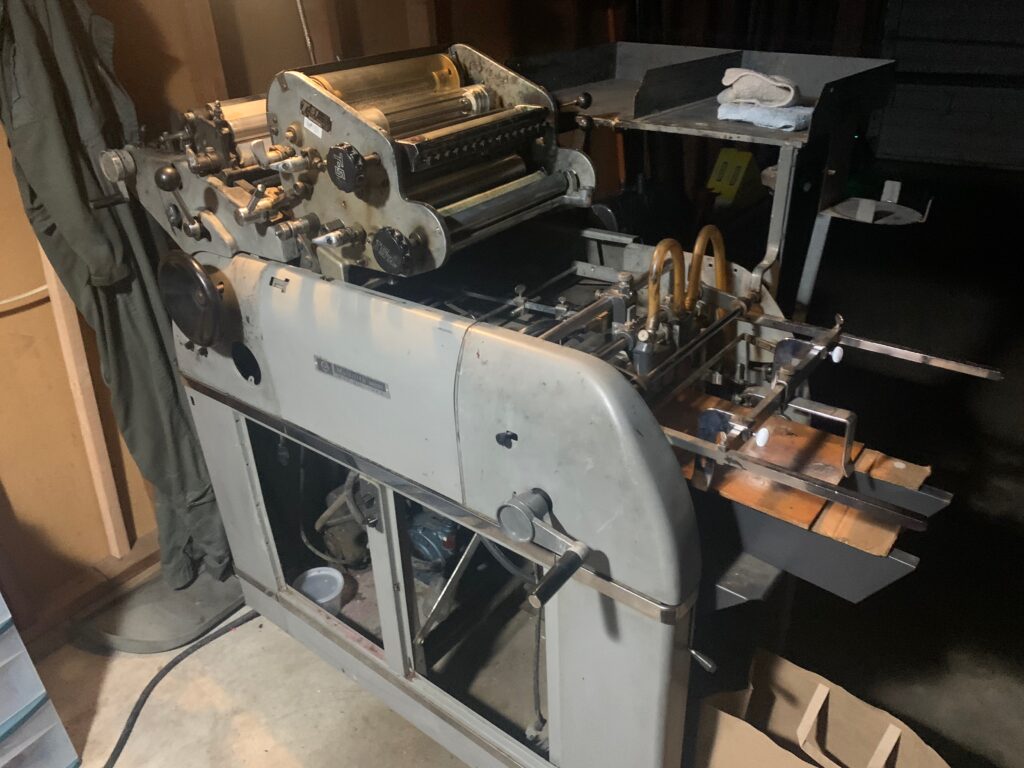
Multilith 1250 Restoration* project
I am not sure what to say about this project, exactly. The short of it is, in June I bought a used Multilith 1250 ‘office duplicator’, and have spent a lot of time learning about these machines – what they were used for, how to maintain and use one, and just exactly how much space one takes up in my garage.
The Multilith 1250 is a compact single-color offset press that was popular in the 1950s, 60s, and 70s, pretty much until the Xerox machine because ubiquitous equipment in the 80s. During their heyday they were used in small to large offices, colleges, the military, even local churches and public schools, to print everything from letterhead and envelopes, to newsletters, manuals, office forms, and really anything else that the business needed paper-wise.
They were also popular among the 60s community and political movements. Many activist groups owned Multilith 1250s because they were easy to use and maintain, and for their professonal-quality duplication. Lots of political literature was printed on these machines by so-called ‘rebel presses’.
One of the things I learned that really made my mind up going into this project is that the Multilith 1250 appears to be the same model of press that Françoise Mouly and Art Spiegelman had set up in their NYC apartment to print their own comics in the early days of RAW Books. So at least from that I knew that this press would serve my needs just fine.


So, why buy an offset press? Well, ever since I started self-publishing my own comics, I dreamed of having a photocopier of my own, to maybe save money on production, but also to make it just that much simpler to take whatever dumb idea I might have and turn it into a finished comic.
I considered buying a used photocopier instead, but kept getting turned off by a few of the inherent limits of digital photocopies. Sure, they could be full-color, but they couldn’t do spot colors without special toner cartridges. Plus the cost of toner refills and likely needing to hire someone to do any maintenance on it was just an unappealing level of expense. There’s also the quality issue – no matter what, a photocopy just looks like a photocopy, you know? And finally, the asking price of the press was remarkably LESS than some of the copiers I was looking at.
The couple times in my own past when I had something printed by a little print shop, I was just so much more pleased with the results than my other photocopied stuff. I realize it’s overkill for such a cheap little comic project like an 8-page minicomic, but I also appreciate just how kind of ridiculous that is. I mean, what’s the point of having a vanity press if you can’t go way overboard on production? So I’m looking forward to having that feeling toward every comic I have printed from now on.
The particular press I purchased (born in 1967, near as I can tell) is a single-color press, but it included an additional print-head called a T-51, which allows for 2-color printing. So this allows me to do two colors in a single pass, making it a lot easier to get good, consistent color registration. It also allows me to do the most ridiculous thing, which is a 2-color anaglyph 3-D mini-comic. Talk about production overkill!

And of course, there is no way I’ll be using this press full-time to make only my own comics, so I also want to make it available to other local artists and community groups to print their comics and zines on. I don’t know yet how that’ll work exactly, like I don’t want to make it a business, but I think if people are willing to pay for their own paper and chip in on the other printing supplies, I could invite them over to see how the press works, and watch their stuff get printed.
Anyway, I think this is going to be a fun new chapter of my art-making life, and before I even got the press I was getting more and more excited just about making comics again, for the first time in quite a while. For that alone, it’s been worth it. I want to set up a page here with links to digital resources for folks who want to learn more about these machines, like digital scans of all the old manuals and reference books I’ve been able to track down in my own research.
*There won’t really be much about ‘Restoring’ this press, since the previous owner kept in really good shape. Despite it going unused for much of the last 20 years or so, the only issues I see with it are a bit of surface rust and a good amount of paper dust build-up. The press fired right up when I plugged it in, and after I replaced a couple degraded rubber hoses and refilled the oil in the vacuum pump, looks like it won’t need more than a thorough lubrication and cleaning before I can start using it to print up my own brand of nonsense!